
Material comparison
GFRP VS STEEL
A clear comparison of GFRP rebar and conventional steel reinforcement — helping you evaluate corrosion resistance, weight, strength and performance for modern concrete construction.
Why compare
GFRP
vs steel.
GFRP (Glass Fiber Reinforced Polymer) rebar is a non-metallic composite reinforcement solution designed for concrete applications where properties such as corrosion resistance, low weight and non-magnetic performance are important. Steel rebar remains a widely used reinforcement material, but GFRP rebar offers a different set of material characteristics that can make it suitable for specific construction and infrastructure applications. The following comparison highlights the key differences between GFRP rebar and conventional steel reinforcement.
Explore SolidCore GFRP Rebar or contact us for project guidance.
Key differences
Where GFRP
stands apart.
Corrosion Resistance
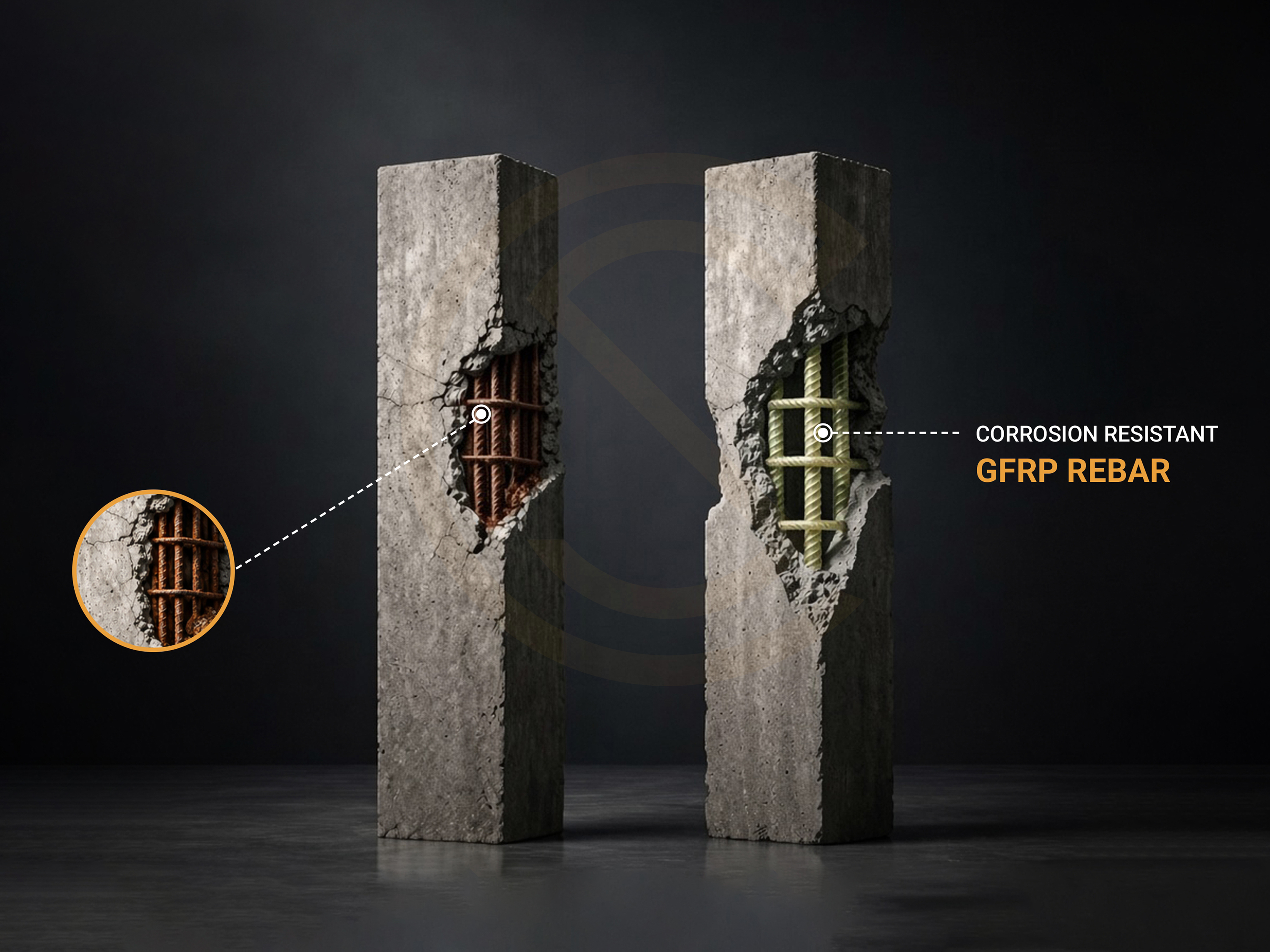
One of the major advantages of GFRP rebar is its resistance to conventional steel corrosion. Because GFRP is made from glass fibers and a polymer matrix rather than metal, it does not rust like steel reinforcement. This makes GFRP rebar particularly relevant for concrete structures exposed to moisture, chlorides, marine conditions and other corrosive environments. For projects where corrosion-resistant reinforcement is a priority, GFRP can be considered as an alternative to conventional steel rebar.
Lightweight Reinforcement
GFRP rebar is significantly lighter than steel reinforcement, which can make transportation, handling and placement easier at the construction site. Its lightweight nature can be useful for contractors working with large quantities of reinforcement or projects where reducing manual handling is important. As a lightweight rebar solution, GFRP reinforcement can simplify site logistics while still serving as reinforcement within properly designed concrete structures.
High Tensile Strength
GFRP rebar can provide high longitudinal tensile strength and is designed to carry tensile forces within reinforced concrete applications. However, GFRP behaves differently from steel under load because it does not yield in the same way as conventional steel reinforcement. For this reason, GFRP concrete reinforcement should be selected and designed according to the applicable engineering requirements rather than treating it as a direct one-to-one replacement for steel in every application.
Non-Magnetic Properties
GFRP rebar is a non-metallic and non-magnetic reinforcement material. This characteristic can be valuable in applications where magnetic interference needs to be minimized, including certain medical, research, electrical and specialized infrastructure environments. Unlike steel rebar, GFRP reinforcement does not introduce the same magnetic properties associated with conventional steel reinforcement.
Non-Conductive Performance
Another important difference is electrical conductivity. GFRP rebar is electrically non-conductive compared with steel, which makes it useful in applications where electrical insulation or reduced electrical conductivity is required. This property expands the potential use of composite rebar in specialized concrete structures where conventional metallic reinforcement may create unwanted electrical or electromagnetic effects.
Performance in Harsh Environments
Concrete structures exposed to water, salts, chemicals and other aggressive environmental conditions can face reinforcement-corrosion challenges when steel is used. GFRP reinforcement provides an alternative where corrosion resistance is an important part of the material selection process. This makes GFRP rebar relevant for applications such as marine structures, water infrastructure, industrial construction, bridges, parking structures and other demanding concrete environments.
Easier Handling and Installation
The lower weight of GFRP bars can make them easier to move, cut and position during reinforcement work. For construction teams, easier handling can be particularly useful on projects involving large reinforcement quantities or difficult access conditions. GFRP rebar installation still requires proper detailing, cutting, bending and placement practices based on the product and project requirements, but its lightweight characteristics can offer practical site advantages.
Different Structural Behaviour
GFRP and steel do not behave identically under structural loading. Steel is known for its ductile yielding behaviour, while GFRP has a different stress-strain response and does not yield in the same manner. GFRP also has a lower modulus of elasticity than steel, which can influence crack width and deflection considerations. Therefore, GFRP reinforced concrete should be designed using appropriate GFRP-specific engineering provisions and not simply by substituting GFRP bars for steel bars without checking the design requirements.
Durability and Maintenance Considerations
Because GFRP does not undergo conventional steel rusting, it can help address reinforcement-corrosion concerns in suitable applications. This can be an important consideration when planning durable concrete structures in environments where corrosion can become a major long-term concern. The actual service performance of any reinforcement system depends on design, manufacturing quality, concrete conditions, exposure, installation and the requirements of the specific project.
Wide Range of Potential Applications
GFRP rebar can be considered for a range of concrete construction and infrastructure applications where corrosion resistance, lightweight reinforcement or non-metallic properties are beneficial. Potential applications include bridges, marine structures, water-related infrastructure, industrial floors, tunnels, parking structures and other reinforced-concrete projects. SolidCore Composite, based in Morbi, Gujarat, focuses on composite reinforcement solutions such as GFRP rebar for the evolving requirements of modern construction and infrastructure.
Performance comparison
SolidCore GFRP vs.
steel rebars.
Mechanical properties
| Properties | Steel Rebars | SolidCore GFRP Rebar |
|---|---|---|
| Tensile strength (Mpa or N/mm²) | 500-600 | 1000+ |
| Shear strength | 120 | ≥152 |
| Bond strength (Mpa or N/mm²) | 14 | 211 |
| Compression (Mpa or N/mm²) | 500 | 450 |
| Modulus of elasticity (Gpa) | 160-200 | ≥50 |
| Elongation (%) | 25 | ≥1.5 |
| Durability | Terms are prescribed in special building codes | 80 years + |
| Density (Ton/m³) | 7.8 | 1.9 |
| Corrosion resistance to aggressive environment | Appearance of rust | Stainless material preserving properties even in alkaline concrete environment |
| Ecological compatibility | Ecologically friendly material | Does not emit harmful and toxic substances during storage and use |
| Electrical conductivity | Electrically conductive material | Dielectric |
Size equivalency
Table of substitution
by tensile strength.
SolidCore GFRP Rebar
| Diameter | Weight (Per 1 meter bar) | Weight (Per 12 meter bar) |
|---|---|---|
| 6 mm | 0.059 | 0.708 |
| 8 mm | 0.106 | 1.272 |
| 10 mm | 0.165 | 1.980 |
| 12 mm | 0.237 | 2.844 |
| 14 mm | 0.323 | 3.876 |
| 16 mm | 0.422 | 5.064 |
| 18 mm | 0.534 | 6.408 |
| 20 mm | 0.659 | 7.908 |
| 22 mm | 0.798 | 9.576 |
| 25 mm | 1.030 | 12.360 |
| 28 mm | 1.292 | 15.504 |
| 30 mm | 1.484 | 17.808 |
| 32 mm | 1.688 | 20.256 |
Steel Rebars
| Diameter | Weight (Per 12 meter bar) |
|---|---|
| 6 mm | 2.75 kg |
| 8 mm | 4.74 kg |
| 10 mm | 7.40 kg |
| 12 mm | 10.65 kg |
| 14 mm | 14.52 kg |
| 16 mm | 18.93 kg |
| 18 mm | 24.00 kg |
| 22 mm | 35.76 kg |
| 25 mm | 46.22 kg |
| 28 mm | 58.02 kg |
| 32 mm | 75.79 kg |
Note
- Weight of individual bars may vary within an allowable tolerance of ±2%.